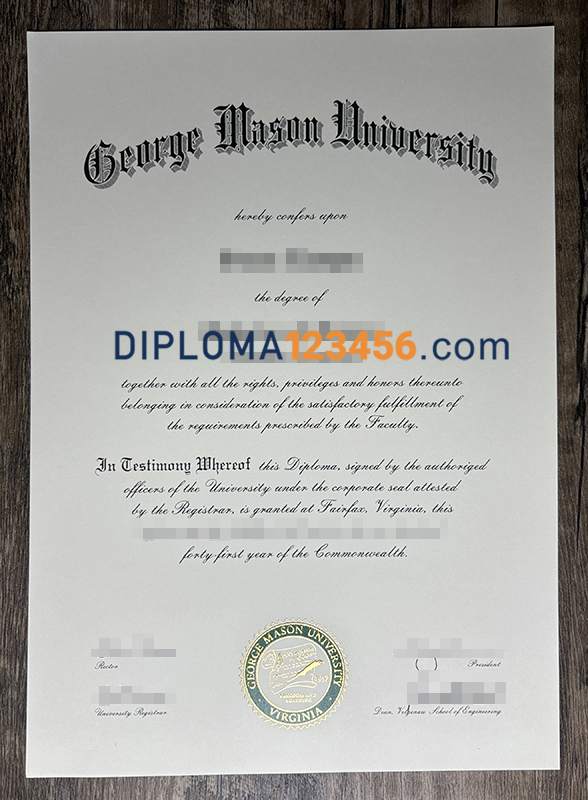
It began in 1957 as an extension center of the University of Virginia, with the initial mission of serving adult learners and military veterans in Northern Virginia; it did not become an independent institution until 1972. Yet, in just a few decades, it has evolved into the youngest R1 research university in the United States. Today, it stands as the largest public university in Virginia, with a student body—comprising both undergraduates and postgraduates—exceeding 40,000, drawn from all 50 U.S. states and 130 countries. Lacking the colonial-era architecture or the centuries-old endowments found at older institutions, the university has been built almost entirely from the ground up over the last half-century. George Mason University diploma, George Mason University degree.
The precursor to George Mason University was the Northern Virginia University Center, established in 1957 with a clear, specific goal: to provide educational opportunities for local working adults and military veterans. When the Fairfax campus opened in 1964, it spanned only 150 acres; by 1968, the university saw its first graduating class of 58 students. In 1972, the Governor of Virginia signed legislation separating George Mason College from the University of Virginia, establishing it as an independent university. This timing proved pivotal—Northern Virginia, benefiting from its proximity to Washington, D.C., experienced rapid expansion, transforming from a mere "bedroom community" for the nation's capital into one of the most economically vibrant regions in the United States. George Mason University grew in tandem with this regional surge.
In 2004, with an enrollment of 28,750 students, George Mason surpassed Virginia Tech to become the largest public university in the state. By 2025, that figure had climbed to 40,378. Even more notable is its research profile: George Mason identifies itself as "the youngest R1 research university in the United States." The "R1" designation—the highest classification for research activity under the Carnegie Classification of Institutions of Higher Education—is typically reserved for universities with a history spanning a century or more. George Mason University’s reputation is, to a large extent, a product of its deep integration into the economic fabric of Northern Virginia.
The layout of the university’s campuses mirrors the industrial geography of the region. #GMU diploma, #GMU degree, #GMU certificate. The main campus in Fairfax serves as the hub for undergraduate education. The Mason Square campus in Arlington—situated along the Metro line and just a few stops from Washington, D.C.—focuses on law, policy, and government; it houses the Antonin Scalia Law School, the Schar School of Policy and Government, and the Jimmy and Rosalynn Carter School for Peace and Conflict Resolution. Meanwhile, the Science and Technology Campus in Manassas is embedded within Innovation Park, surrounded by technology firms and federal agencies. It hosts one of only 13 Biosafety Level 3 (BSL-3) laboratories in the United States, as well as one of just eight outdoor forensic science research facilities in the world.
This strategic positioning is reflected in the university’s rankings. In the 2025 *U.S. News & World Report* graduate program rankings, George Mason’s public affairs program ranks first among public universities in Virginia and 36th nationally. Its systems engineering program ranks 37th in the nation, while the School of Nursing’s Doctor of Nursing Practice (DNP) program places in the top 6% nationwide. The Antonin Scalia Law School ranks 31st nationally and 11th in the country for the placement of graduates into federal judicial clerkships. A common thread runs through these rankings: they measure professional outcomes and real-world impact within specialized fields, rather than the selectivity of undergraduate admissions. Ken Ball, Dean of the College of Engineering and Computing, explains the rankings quite plainly: "Northern Virginia is home to 13% of the world’s data centers, and we are expanding our engineering and computing programs to meet the region’s demand for technical talent."